September Chrysanthemums and the Sake Cup – Why Is Gu-jja So Special?
When you spread out the September Hwatu cards, they are full of chrysanthemums. But one very suspicious card is mixed in this month. A sake cup tucked in quietly among the flowers! Why a sake cup in a flower garden? Today I will tell you the hidden story of the September cards and the tale of the card with the roughest fate (?) in the game, Gu-jja .
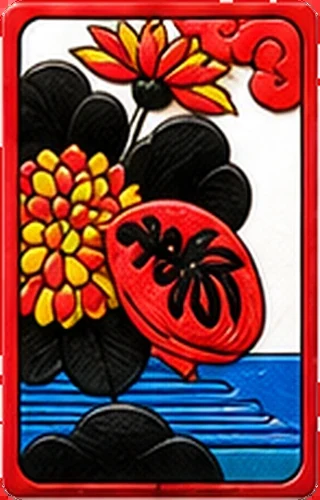
Sake cup Animal
|
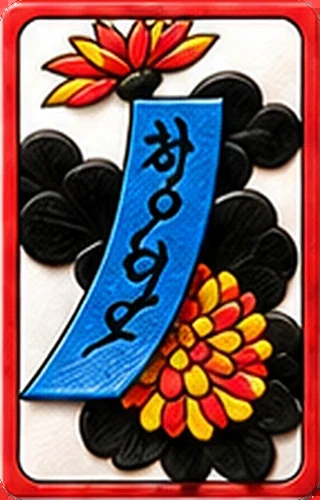
Blue Ribbon
|
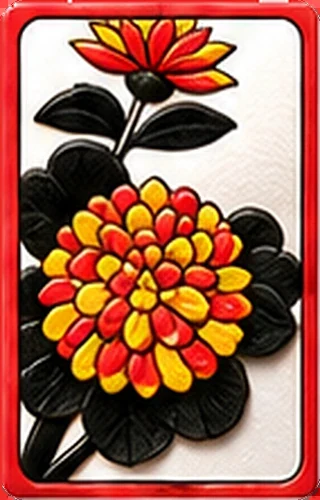
Chrysanthemum Junk
|
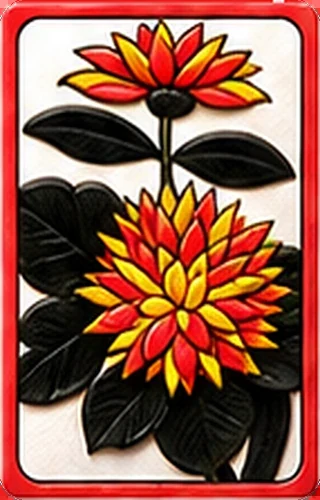
Chrysanthemum Junk
|
A sake cup in a flower garden? The story of chrysanthemum wine
On the old calendar, the ninth day of the ninth lunar month is Jungyangjeol (Double Ninth Day). It is said to be named that because the number 9, which carries the strongest yang (odd) energy, doubles up on that day. On this day, there was a custom of climbing to a high place to enjoy the view, and of making chrysanthemum pancakes and drinking chrysanthemum wine . Isn’t it wonderful just to imagine a cup of wine under the autumn sky with a single yellow chrysanthemum floating in it?
So it is no accident that a sake cup is placed on the chrysanthemum picture. Hwatu September is a month where ‘chrysanthemum + cup’ go together as one set. In Japanese Hanafuda, this cup is said to have the character for long life and blessing (寿, pronounced ‘kotobuki’ in Japanese) written on it. It would mean a cup for a celebration. In this game’s picture, a red cup sits on blue waves, and the character looks like a smudged pattern. Open your eyes wide and find out for yourself which character it is!
Hidden pictures: the Blue Ribbon
The second September card is the Blue Ribbon. A blue ribbon runs across the chrysanthemums, and there is a black pattern on the ribbon that looks like writing. It is said that the Blue Ribbon on the original Japanese card has no writing. There is a story that it was drawn differently when it was made in Korea, but the exact reason has not been passed down. We will tell you more about the stories around the ribbons in
The Story of Red, Blue and Grass Ribbons
.
In the game, ‘Gu-jja’ is the star
The September sake cup Animal is called Gu-jja (the September Animal), or sometimes ‘Gukjin.’ The exact origin of the name is not certain, so just know that ‘that is what people call it.’
What makes this card special is that although it is an Animal, it can also be used like a Double Junk. In HealingMatgo, when you capture Gu-jja, the game asks ‘Move it to Double Junk?’ . If you choose ‘Yes,’ it is worth 2 Junk instead of an Animal.
- If you are collecting Animals, then leave it as it is (it has nothing to do with Animal points or Godori, but it adds to your Animal count)
- If you are short on Junk and just one point short of scoring, then move it to Double Junk
- If the Double Junk Squad mission (capture Gu-jja, the November Double Junk, and the December Double Junk) is on the line, then it is a mission card, so capturing it first is what matters
It is a card with the flavor of deliberation. By the way, if you do not answer the question before time runs out, ‘Yes’ is chosen automatically. Be careful, because while thinking at leisure it may turn into a Double Junk!
A little joke
There is a joke that goes, “If you see a sake cup, let’s have a drink first.” But the sake cup in HealingMatgo is not for drinking but a cup for moving. There is nothing to get drunk on and no money to bet, so rest easy and enjoy.
Old tales and legends are told a little differently depending on the book and the region. This article retells the commonly known story in simple words.
If you are curious about the scoring rules, please also read the HealingMatgo Score Calculation Guide.