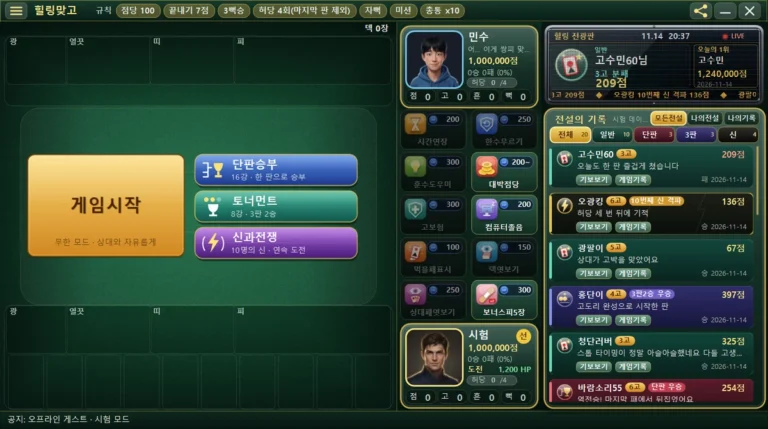
HealingMatgo scoring guide: Brights, Animals, Ribbons and Junk, plus Go, penalties and multipliers
“I have no idea how many points I got.” That is what most first-time HealingMatgo players say. This guide covers how points build up, how they get multiplied, and what is exchanged at the end all in one place. Follow along slowly and it is not hard.
1. Where do you see your score?
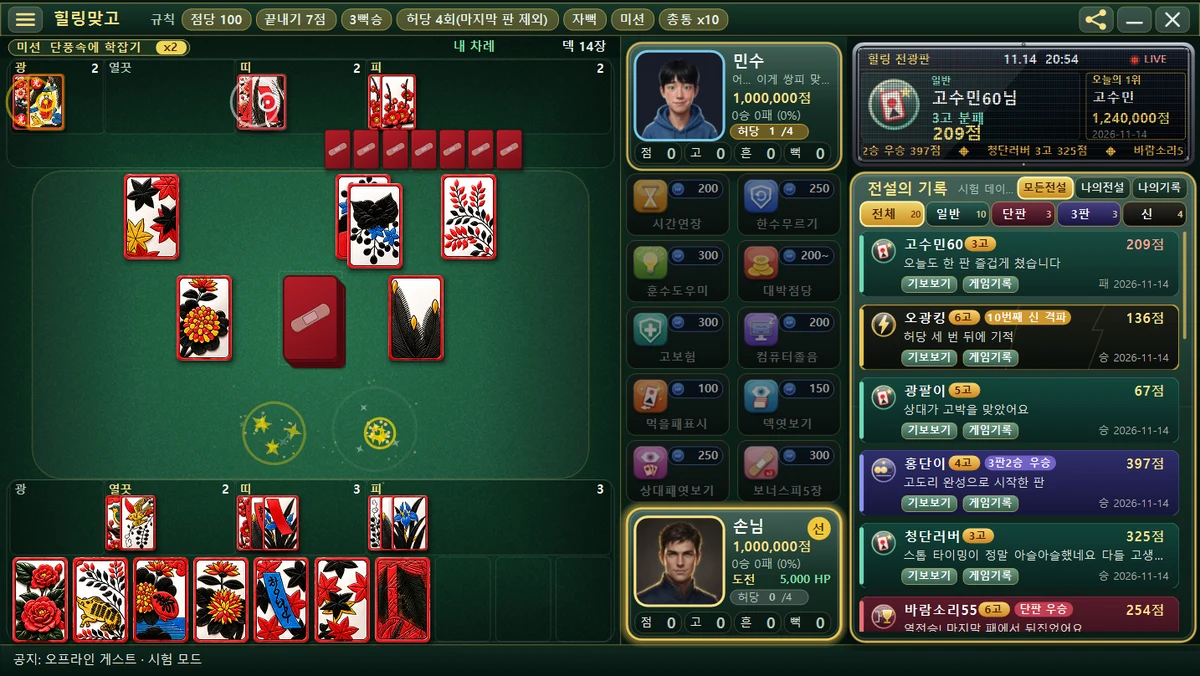
Below each player’s box on the board there are four boxes: pts · Go · Shk · Ppk. “pts” is the score you have collected so far. Each time you capture a card, the counts in the Bright, Animal, Ribbon and Junk boxes above go up, and your score is set by those counts.
2. Score table by card type
| Type | Score |
|---|---|
| Bright | 3 Brights 3 pts (2 pts if the Rain Bright is among them), 4 Brights 4 pts; 5 Brights score very high |
| Animal (Meong) | From 5 cards: (cards − 4) pts. 5 cards = 1 pt, 6 = 2 pts, 7 = 3 pts… |
| Godori | Collect all 3 bird Animals (Feb, Apr, Aug) for +5 pts |
| Ribbon | From 5 cards: (cards − 4) pts |
| Red / Blue / Grass Ribbons | Collect all 3 of each for +3 pts |
| Junk | From a total of 10 or more: (total − 9) pts. Double Junk counts as 2, a single Junk as 1 |
- 5 Brights: Jan, Mar, Aug, Nov, Dec (the Dec Bright is the Rain Bright)
- 3 Godori cards: the Feb, Apr and Aug Animals (birds)
- Red Ribbons: Jan, Feb, Mar Ribbons / Grass Ribbons: Apr, May, Jul Ribbons / Blue Ribbons: Jun, Sep, Oct Ribbons
- When you capture the Sep Animal, you are asked “Move it to Double Junk?” If you move it, it counts as 2 Junk.
Five Brights are worth a lot, so they are a big chance to change the course of a round. Please check the exact numbers in the result window of each round.
3. Go and Stop
When your score is at least the Finish score (7 pts) and higher than your score at your last Go, a “Go?” window appears. Press Stop and you win and the round is settled; press Go and the round continues.
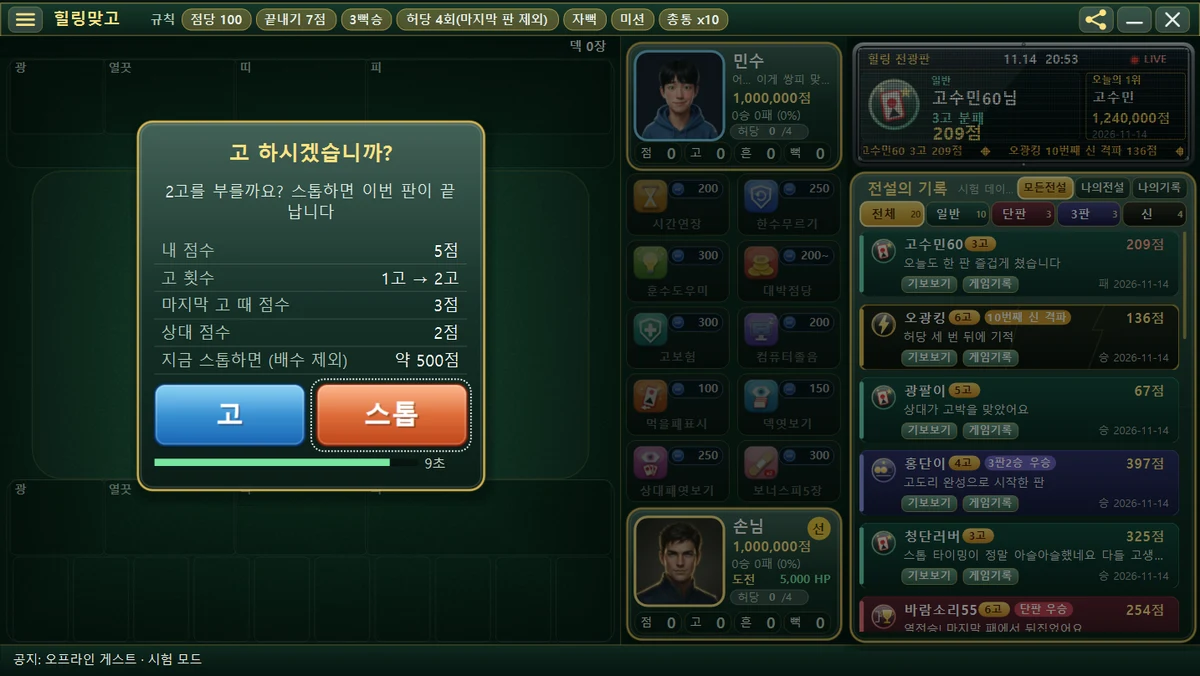
- Each time you call Go, the winner’s score gets +1 pt (1 Go +1, 2 Go +2…).
- If your score does not go up after you call Go, you are not asked again at the same score.
- On your last 10th move, the round is settled right away without a question.
- If both sides use all 10 moves and nobody finishes, it is a draw (no points move). It is also a draw if the deck runs out.
4. Multiplying after a win: the order of multipliers
The winner’s base score is current score + Go count. If any of the items below apply, they are multiplied in order. At the end, × Point rate (100) gives the points that actually change hands.
| Order | Item | Multiplier |
|---|---|---|
| 1 | 3 Go or more | 3 Go ×2, 4 Go ×4, 5 Go ×8 … |
| 2 | Shake · Bomb | ×2 for each time (1 time ×2, 2 times ×4) |
| 3 | First Ppeok | ×2 if you made a Ppeok on your first move |
| 4 | Meongtta | ×2 with 7 or more Animals |
| 5 | Go Penalty | If the side that called the last Go lost, the winner gets ×2 |
| 6 | Mission success | Mission multiplier (×2 or ×3) |
| 7 | Bright Penalty | ×2 if the winner has 3 or more Brights and the loser has 0 Brights |
| 8 | Junk Penalty | ×2 if the loser has few Junk compared with the winner, who collected many (check the exact card-count rule in the ‘Junk Penalty’ label on the result window) |
| 9 | Animal Penalty | ×2 if the winner has 5 or more Animals and the loser has 0 Animals |
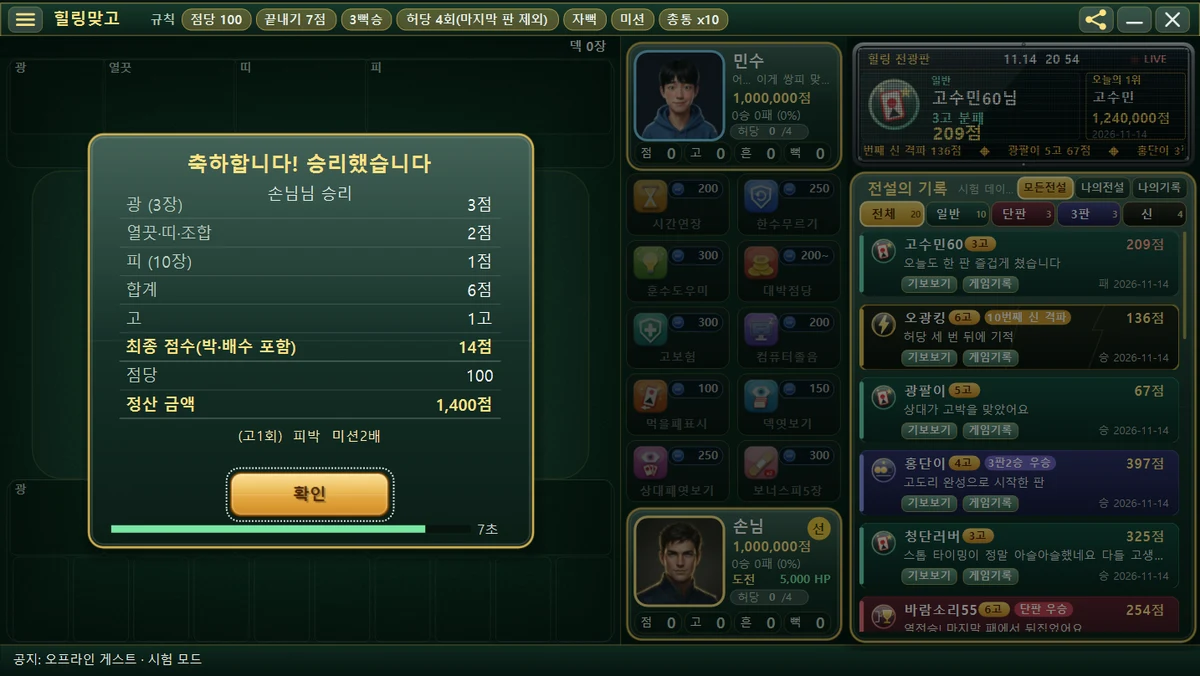
If the loser did not capture a single card, the result is 0 pts even though you won.
5. Reading the labels in the result window
The bottom line of the result window shows, in words, the penalties and multipliers that applied to the round. These include Bright Penalty · Junk Penalty · Animal Penalty · Go Penalty · First Ppeok · Meongtta · Shake N times · Mission xN. If you are not sure what one means, check the table above again. If you used the item Go Insurance and lost after calling Go, the Go Penalty is waived and the score is halved (rounded up).